
1. Introduction
In 2014, The Missing Picture became the first film in Cambodian history to receive an Oscar nomination in the Best Foreign Language Film category. Before that, the film premiered in the Un Certain Regard section of the 66th Cannes Film Festival, where it won the main prize. Beyond that, the film has travelled extensively to festivals and competitions worldwide: Adelaide, Chicago, Jerusalem, London, Turin, and Ghent, among others. We can assert that The Missing Picture is the most famous work in the Cambodian filmmaker Rithy Panh’s filmography for all these reasons. He has explored different genres and cinematic forms to investigate the reconstruction of society’s collective memory as the first stage for elaborating a principle of justice that goes beyond recognising the victims of the catastrophe and identifying the guilty parties (Martín Sanz, 2018: 213). The director has dedicated his career to constructing various films that delve into the roots of the genocide to perpetuate it on screen, so it is not forgotten, thus facing the “memory erasure machine” of the revolutionary regime (Couteau, 2000: 20). His films can be understood as a collective intertwining of different characters that seeks to unveil a careful thematic fragmentation that investigates the remnants of the terror of Pol Pot and his Khmer Rouge’s Democratic Kampuchea from the traces of the present.
The film begins with a biographical introduction of a young Rithy Panh, who manages to escape into exile as a political refugee in France after losing his family. In Paris he trained as a filmmaker at the Institut des Hautes Études Cinématographiques (IDHEC)1. After graduating, the creator returned to his native country to create a series of both fiction and non-fiction approaches to the genocide. It is estimated that approximately 25% of the Cambodian population disappeared (Margolin, 1997: 816-900). The lack of archival images of the catastrophe leads the filmmaker to confront both the absence of representations that prove the barbarity, thus corroborating the survivors’ testimony and the propagandistic images that promote the virtues of the overthrown regime. Due to these circumstances, his films are part of this quest to re-establish the truth, creating a kind of counter-memory of the genocidal event (Rollet, 2011: 216) so that his works can be seen as mourning rituals. The filmmaker
seeks to re-establish the truth, to analyse the Cambodian genocide, to fight against erasure, to give life, it also acts as a ritual of mourning, for itself and for Cambodian society as a whole, seeking to prevent the survivors from sinking into madness haunted by its spectres (Lefeuvre-Déotte, 2016: 7).
Or in the filmmaker’s own words: “I came to cinema to save myself, it’s not even the way to express myself; it’s either die or make this film [about S-21]”. (Panh in Tavernier, 2002). In addition to being a personal testimony, the clarifying and even pedagogical function of the history of their narratives causes their films to constitute a new collective imaginary of memory figures (Assman, 1995: 129) –based on ideas, images, and various representations– for the post-memory generation, a concept that “describes the relationship of the “generation after” to the personal, collective and cultural trauma of the previous generation, that is, their relationship to the experiences they ‘remember’ through the narratives, images and behaviours in the midst of which they grew up” (Hirsch, 2012: 19). Thus, the representations that Panh creates supplant the absence of images that do not exist (Martín Sanz, 2018b: 187). The filmmaker thus joins a whole generation of filmmakers who use different cinematographic resources to create a more intense memoristic spectrum than that of the oral account through strategies that unite theatrical actions, discourses, and physical vestiges of the past (Ferrer and Sánchez-Biosca, 2019: 49).
A complexly elaborated cinema is formed, which, like a jigsaw puzzle, searches for today’s surviving pieces in an attempt to fit them into a commonly accepted story. This acceptance seems to become the first ethical postulate that Panh establishes in his working method, which, far from seeking general solutions to essential questions or establishing the chronology of the events in as much detail as possible, as Claude Lanzmann does in Shoah, clings to the witnesses’ accounts of the memory (through the recording of their testimony) or (through the documents they have left behind). However, it is worth mentioning that when it comes to creating the different narratives that his works trace, far from the testimonial strategy employed by the aforementioned French filmmaker, Panh makes use of the image, resorting to all the archive materials that he can rescue from oblivion:
In my office in Phnom Penh, metal cabinets form a wall. They contain letters, notebooks, sound recordings, archives, devastating statistics, and maps. Next door, an air-conditioned room contains hard drives: photos, radio recordings, Khmer Rouge propaganda films, and criminal court statements. All the Cambodian drama is there (Panh and Bataille, 2013: 18).
In this way, Panh rejects Claude Lanzmann’s notion that images can simplify an event that exceeds them and should therefore be destroyed (Lanzmann 2011, 466). Panh takes a stand with Jean-Luc Godard (Bonnaud and Viviant 1998) and Didi-Huberman, who, following an exhibition of four famous images taken by a member of the Sonderkommando in Auschwitz, writes an article in which he argues for the safeguarding of any kind of representation:
To assert, against the thesis of the unimaginable, that there are images of the Shoah is not to claim that “everything real is soluble in the visible” and that the entire Nazi crime is in four photographic images. It is simply to discover that we can go through these four images in order to focus with a little more precision on what was a reality in Auschwitz in August 1944 (Didi-Huberman, 2004, 170).
In the case of Rithy Panh, this use of surviving archival materials –which is recurrent in his filmography– is due to the disappearance of much evidence of the genocide. Even if we consider film as a perishable art, works that tend to disappear, as Soko Phay points out, the Khmer Rouge’s destruction is mainly responsible for the fact that of the nearly four hundred films produced in Cambodia from 1960 to 1975, only about thirty remain in poor condition today (Phay, 2017: 149). Another significant example is that only a few images taken by the French photographer Roland Neveu survived the seizure of the city of Phnom Penh by the revolutionary army on 17 April 1975 (Ly, 2017: 169).
In this way, the Cambodian director develops an entire cinematography which, although it does not vary in its primary method of approach, evolves in its characteristics and approaches to the subject, which is the main focus of interest in his films. It presents different representations which, far from substituting each other, show different complementary techniques that portray different points of view of the period of the Khmer Rouge in Cambodia. A working method that combines the few surviving images with the words of the survivors, victims, and executioners. This approach, which goes beyond attempting to make a complete x-ray of the causes and factors that led to the genocidal phenomenon, seeks to delve into its aftermath through the survivors’ testimony. In this regard, it is worth noting that the confrontation between one and the other, as well as the blurred boundaries between fiction and documentary in some of his works, have been the notions that have led him to be accused of a certain ethical ambiguity concerning the treatment of certain situations (Hamilton, 2013: 185). His work is criticised because of how the figure of the executioner is conveyed; far from condemning them, he seeks to understand the person’s ideological postulates.
An example of this is the closeness in the interview with the former leader Duch in the third film of his trilogy on S-21.
The Missing Picture (L’image manquante in the original) questions the non-existence of genocidal images from its very title, “the lack indicates a felt need or deficiency: it refers to something that should be there but is not” (LaCapra, 2005: 74). Faced with this absence of traumatic images that do not exist, Panh takes it upon himself to recreate them through clay figures that refer to those he moulded in his childhood (Torchin, 2014: 37). In this way, a story is configured through a poem format that reverberates in the lyrical creation of the also surviving Jean Cayrol in Alain Resnais’ Night and Fog (1956), providing a poetisation of the creator’s testimony in the first person: “The narrative has an I as its central axis: Rithy Panh himself” (Zylberman, 2015: 119). In the words of Bataille, co-writer of the screenplay:
His indications were more like those of a director: “More poetic,” darker”... They must have been a bit like poetic slogans. I deduced that there would be a voice-over, but I didn’t know who would speak. Everything was allusive (Bataille in Ekchajzer, 2013).
Thus, starting from a poetisation of one’s own testimony, The Missing Picture develops a chronological discourse on individual memory in the context of genocidal circumstances. Above all, Panh’s purpose is to generate those images that exist only in his memory. Therefore, memory generates the ethical postulate about the veracity of the representations, which the other survivors also accept. “The Missing Image operates a shift of register towards the intimacy of experience, the echo and reminiscences of all these images and acts of memory that persist.” (Sánchez-Biosca, 2018: 2). In this sense, Panh’s work offers a cinematic extension of the canvases of the painter Vann Nath –the protagonist of his celebrated trilogy on S-21–, which stands as a quest for justice in a period of impunity for many revolutionary leaders (Nath, 1998: 188).
This article analyses the film from a cultural studies perspective on memory and trauma using a methodology based on textual analysis that performs a hermeneutics of the images in the film. Therefore, the study attempts to unravel the iconography of the images of trauma present in the film. Our research hypothesis is based on the idea that Rithy Panh’s non-fiction proposal does not so much seek an absent image (or images) of the Cambodian genocide, as his title indicates, but instead proposes an appropriate methodology for bearing witness to personal trauma that could apply to other traumatic phenomena. A study is composed of three elements to argue in favour of this idea: the representations of the perpetrators, the inclusion of fantasy in the narrative, and, finally, the creator’s metaphorical apology of the testimony. Therefore, to carry out this analysis, eight scenes have been selected, considered the most representative of the film when formulating these three elements. Although these sequences do not account for more than 30% of the footage as a whole –mainly due to the brevity of some of them– the explicitness of their message through the voice-over, or the images they contain, means that they are of vital importance for this study.
2. Against images of the perpetrators
Following Sánchez-Biosca (2015: 5-6), we can establish a division of four types of images within the typology of images of trauma: firstly, there are the images taken by the perpetrators, captured to identify their enemies with the ulterior motive of destroying them. The second type of images are those taken by the liberators to discredit the regime that had just been overthrown by showing remnants of the tragedy. Examples of this are the photographs taken by the Russian army at the liberation of Auschwitz or those of Vietnamese troops entering Khmer Rouge Cambodia. The third group is made up of images taken by journalists or filmmakers who, motivated by the defence of human rights, try to use their images to make a statement to the international community. Therefore, these types of enduring images meet the standards of criminal evidence (Winston, 2012: 98-99). Finally, all the image-creations made by the victims after the event try to reconstitute the scenes they have lived through, as is the case with the images created by Panh.
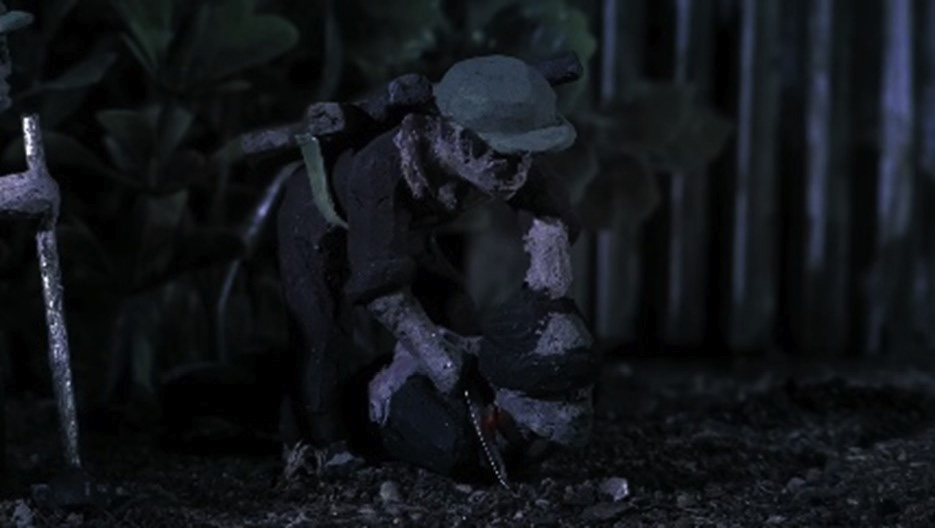
The Missing Picture is a testimonial plea against the first typology of images taken by the perpetrators themselves. This problem is explicitly exemplified near the middle of the film. Panh shows a night-time recreation of a Killing field, presumably that of Choeung Ek, as it was there that most of the Tuol Sleng (S-21) prisoners were exterminated (Williams, 2004). These images seek to fill the gap in the archival footage shot by the Vietnamese at the detention center’s liberation by including both executioners and victims. Panh attempts to construct a representation of a series of missing images, the photographs taken by the Khmer Rouge of the condemned seconds before their execution. He recreates a scene where a figurehead points his camera at the victim, kneeling on the ground and blindfolded. He accompanies these images with a lyrical testimony in which he shows his thoughts on the dissemination of images of perpetrators:
Why?
Was evidence needed?
To complete a dossier?
What man?
having photographed
this death scene,
would want it not to be lost?
I am looking for this image.
If I find it in the end,
I won’t be able to show it, of course (Panh, 2013b: 24).
They are images of death created to testify brutality. Far from wanting to erase or hide the crime, the essence of their existence is to prove that it has been committed. Thus, he brings back the approach of showing the moment of execution that was already present in his famous work on S-21. This, in turn, gives rise to a specific relationship of voyeurism between the photographer and the spectator, who can quickly become an accomplice when attracted to the material. Following Sontag: “As objects of contemplation, images of the atrocious can satisfy several different needs. Strengthen us against weaknesses. To make us more insensitive. To recognise the existence of the irremediable (Sontag, 2010: 85). In line with Lanzmann’s earlier remarks, Panh rejects its possible dissemination; however, he recovers the moment of their creation through the distance of the staging of his figures, a lost image as well. With a shorter shot duration than the previous ones, the camera pans quickly from another individual armed with a camera to the execution scene, which takes place in that precise frozen instant. A Khmer Rouge is preparing to slit their victim’s throat (fig.1). Despite the darkness of the shot, lit with bluish tones to simulate night, a bright red dot, as if coming from outside, glistens on the clay machete, simulating the blood that is about to spill in this nightmarish scene.
Fig. 1. A Khmer Rouge prepares to slit his victim’s throat
Source: Still from The Missing Picture
Faced with the anonymity of a representation that provides nothing more than human brutality, Panh turns to the victims. The filmmaker then shows another type of image taken by the perpetrators. A current recording pans through a permanent exhibition that has been installed since 1979 in Tuol Sleng prison, consisting of hundreds of images taken by the Khmer Rouge of their victims (Caswell, 2014: 4). This massive archive of photographs, taken when detainees arrived at the prison, still raises many questions about its function. The purpose of photographing victims whose subsequent execution was already known is thus unknown (Sánchez-Biosca, 2015: 155). Panh’s camera movement ends by zooming in on a photograph of Bophana. He discovered this young woman’s tragic story (Panh, 2009: 169) in the work Les larmes du Cambodge (Élisabeth Becker, 1988) and made one of his first famous non-fiction films based on this photograph, Bophana, a Cambodian tragedy (Bophana, une tragédie cambodgienne, 1996), investigating the murder of this woman and her partner. Panh leaves the young woman unknown, and the film moves on to the propaganda material filmed by the Khmer Rouge in the labour camps. Images filmed from a certain distance allow us to observe the magnitude of the collective work.
The voice-over explains the general propaganda shots of workers carrying out various tasks in the new regime’s works throughout the film. In this way, the narration delves into the details that the archive image does not allow us to see. Thus, Panh uses words to bring the filmed subjects closer to each other:
I watch the propaganda films
of the Khmer Rouge,
these children they carry.
Their hands. Their faces. Their tired bodies.
their tired bodies.
This young vanguard is working
for its own destruction (Panh, 2013b: 25).
The filmmaker decides to intervene further in the propagandistic archive image by superimposing a figure of a Khmer Rouge cameraman filming the scene in the foreground. This figure rotates, turning the archive around and filming the viewer, pointing his lens out of the field. Despite the reality of the images in the archive, the filmmaker reminds us that the cinematic image is not neutral. Far from being neutral, it can be turned into an instrument of destruction or fantasy (Torchin, 2014: 38). Or, in the words of the filmmaker: “A Khmer Rouge film is always a slogan” (Panh, 2013b: 34). In line with this, a series of archival images are presented that are a far cry from those that seek to praise the new state. They are not as well preserved; they are less elaborately framed and closer to the subjects that are filmed from the same height. There is a certain sense that it has been filmed in hiding–like when Panh shoots his figures behind branches or vegetation in the foreground. Similarly, the rawness of the images is nothing like the previous ones. There are mountains of mud in a chaotic environment with workers who no longer move quickly; on the contrary, fatigue is a fundamental feature of these scenes.
Despite filming the generality, the images do not focus on the act of work but the subjects themselves. The camera goes beyond filming the actions of the work itself to capture the protagonists’ exhaustion. Thus, a later shot shows a group of workers’ hardship as they hoe the soil. A few others are resting motionless next to them. These images are a far cry from the energy and vigour of the propaganda footage. Panh finally identifies the source:
The person who filmed these images
slow and true
is called Ang Sarun.
He was a Khmer Rouge cameraman (Panh, 2013b: 53).
The cameraman is represented again in the following sequence, in which the clay figure returns. Shots of a Pol Pot congress appear in the background, and in the foreground, as before, the figure armed with the spinning camera seeks to immortalise what goes beyond the official record. As Panh points out, the archive on display is composed of partially veiled images. Panh wonders about the reasons for these properties in the image -are they the filmmaker’s technical error or censorship? What is certain is that the outcome of the character, who is tortured and murdered, seems to answer the question.
Ang Sarum succeeds, with the means of cinema, in signifying that something is dysfunctional in what he gives to see. He films what his sponsor asked him to film, but he manages to bring the visual forms into crisis in order to take the real out of the established order. By thus distilling a slight disturbance, he produces in the leaders such anxiety that he puts their lives in danger (Renard, 2018: 77).
Like a ghost, the editing fuses the figure with the background, causing it to dissolve into nothingness. The character disappears, but not his film. Specific images of trauma are owed to the film, which may well be absent today. In The Missing Image, Panh seems to want to go beyond these propagandistic images in an attempt at continuing Ang Sarum’s mission. In this way, the propagandistic images that show the collective work in general shots that magnify the coordination of the new society are explained through the voice-over’s critical commentary and Panh’s close-ups of his figurines. Panh combines a series of close-ups of his traumatised figures, creating representations that respond directly to the archive by delving into the unseen details set against a backdrop of propaganda, concealing suffering and exploitation.
Fig. 2. Fiction documents reality

Source: Stills from The Missing Picture
3. Building from fantasy
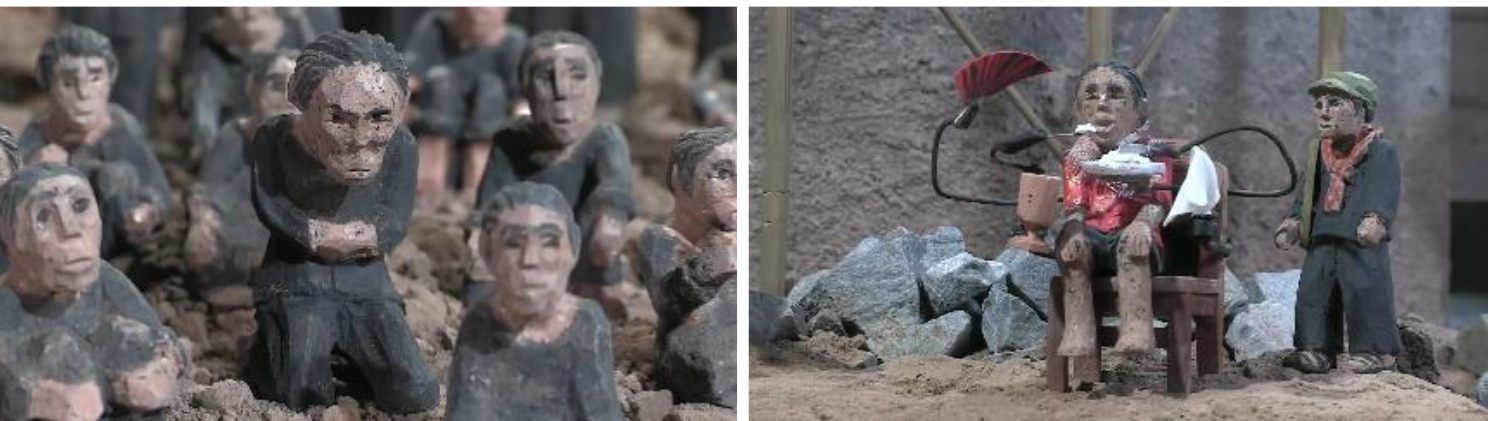
The filmmaker’s proposal develops as a direct testimony in the dioramas, in which he expresses what he experienced as a young Panh figure. However, as the crudeness of the story of his time in a labour camp grows, the filmmaker decides to resort to fiction, reinterpreting the past from the present point of view. These fantasies, inserted into the various representations, codify the childish thinking at the time and offer some respite from the traumatic burden of the testimony. Thus, Panh shows a diorama depicting a re-education session divided into different planes as an example of the first use. At the same time, the narration takes on the Khmer Rouge’s voice, addressing the rest of the group to speak of the future promises and the good of the new society. The faithful representation, which among other details, presents bewildered and even angry listeners, is invaded by fantasy. The fantasy of the discourse is on the same level as the reality that the prisoners are living. Thus, when the voice states that “Les hommes âgés seront nourris par une machine”, Panh inserts into the diorama a machine reminiscent of the one presented by Chaplin in Modern Times (1936) (fig. 3). The filmmaker’s thought, which, as mentioned above, cannot be stolen, seems to respond ironically to the presumed idea of progress disseminated by the soldier. In short, the promise of the absurd is on the same level as abolishing hunger, fatigue, and injustice.
Fig. 3. Feeding machine fantasy
Source: Stills from The Missing Picture
The fanciful construction of the future represented by the feeding machine is amplified by the following diorama, a small example of the anti-utopian society that the Khmer Rouge aspire to build. A new tracking shot reveals Panh’s projection of the future under the revolutionary regime. There is a cloudy grey background, where a fortress stands guarded by armed soldiers in front of which bicycles cross narrow pavements. Red flags are everywhere, and a car among the rice fields, a symbol of progress, is stripped of its primary function to use its engine for agricultural purposes. A new society of contrasts is reflected in the figures’ different attitudes, some are walking crestfallen, and others pedal their bicycles happily.
However, this society is completely dismantled in a later shot. A bird’s-eye view of the diorama is shot from above, dismantling the little happiness that can be glimpsed. At the same time, the green and orderly exterior of the fortress contrasts with the chaotic interior, which is under construction. The figurines replicate the work scenes we have seen in propaganda films. However, the darkness of the shot, as opposed to the clarity of the archive, as well as a greater closeness to the subjects, provoke a sense of tragedy that these films themselves lack. This feeling is heightened when Panh, following the style seen previously, moves closer to the figures, creating different panoramas that, with short shots, show the figures’ dehumanised expressions. With increasing closeness, the filmmaker recovers the lost images of all those victims who have not been able to bear witness to what happened.
Fantasy also serves to reinterpret young Panh’s mood. Thus, in many diorama images, the filmmaker presents himself in a bright pink shirt with yellow polka dots rather than in the Khmer Rouge’s black garb. This characterisation is intended to give emotional meaning to the inanimate figures. Thus, for example, young Panh’s discussion with other prisoners about the arrival of man on the moon is quickly adapted in the form of substitution. Panh wears the same uniform garb as the rest of the figures (fig. 4). Through a subtle vertical pan, a simple conversation is enough for the filmmaker to recreate an atmosphere of oppressive silence while this personal transformation takes place, decomposing the subjects symbolised by the change of clothing. Memories and memory are thus cloistered in the private sphere of thought, with totally uniform discourse and clothing. In this poetic way, Panh resolves an ellipsis of his evolving attitude. “To be invisible meant to be alive; to be almost an individual” (Panh, 2013: 80).
Fig. 4. Costume transformations

Source: Stills from The Missing Picture
Later, Panh gives an account of his routine and tortuous day-to-day life. A later diorama shows him and two other companions carrying different logs through the jungle. Some of the fastest ever presented swift tracking shots are accompanied by music that repeats the same musical cadence. Panh’s performance is trapped in a loop as a prisoner of work, and the harsh way of life is imposed on him. Difficulty in moving forward is represented through the mud on the floor, to which the figurine eventually gives way.
I would like to escape from the mud, from hunger,
from my black clothes.
Walking in the water is a torment.
I fall down from exhaustion (Panh, 2013b: 39).
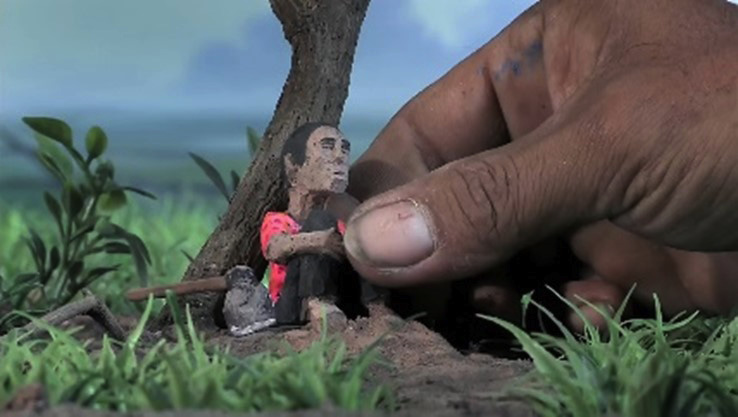
This escape is only possible a posteriori, by sharing the memory. Where the creative act makes it possible to generate a representation that finally saves the impositions, as seen through the choice of the pink shirt as the preferred clothing. Thus, despite reconstructing a tragic past, the film allows the filmmaker to gain control over his traumas, and art is a refuge in his process of relief (Alkan, 2018: 146). Substituting the trustworthiness of the real with imaginary representation is made explicit in the following scene. Panh refers to the moments when a plane crosses the sky under which the prisoners toil. Beyond the questioning of the power of the plane to bear witness to the crime, the director’s hand breaks into the scene to replace the surprised version of himself (in black clothes) with a much more placid one (dressed in the pink shirt) (fig.5). The director reverses the change he made in the night scene in which the young Panh talks about the arrival of man on the moon, restoring the correct order.
Several aspects are interesting in this sequence. For example, the inclusion of the painted plane as a new real plane is introduced into the diorama. As Panh himself later confesses, a plane exists only in his imagination, projecting its wake into the sky as an illusion of an outside entity recording evidence of his pain. In this substitution shot, the filmmaker enunciates the main missing image, “c’est nous.” This phrase coincides with Panh becoming a grey, anonymous, out-of-focus figure in the background. The justification for reinstating this image that motivates the film points to a new re-signification of this painful past. The imaginary plane saves Panh, who in the future recalls the reverie of those moments by rendering them contemporaneously in line with his feelings at the time, the calm and relaxed facial expression, and colourful and cheerful clothes.
Fig. 5. Intervention on fantasy
Source: Still from The Missing Picture
This reverie returns to idealised childhood memories, which contrast the previous images, and are shown in a cheerful and colourful sainete (Phay, 2014: 160). Cambodian rock music from the 1960s accompanies what is perhaps the fastest montage of shots in the film, no doubt motivated by the musical rhythm. The narration pays homage to the guitarist figure with interlacing that jumps from one shot to the next; each shot is only held for a couple of seconds. The guitarist is the filmmaker’s brother who disappeared on 17 April 1975, the city’s evacuation. Without cutting the music, this small diorama jumps to archive images corresponding to the film La joie de vivre (Norodom Sihanouk, 1968) (Besse, 2016: 76).
Smaller, equally cheerful cuts showing people dancing or playing various instruments set the stage for Panh’s brother to appear in the most dreamlike sequence of the whole film. A zenithal shot on the diorama, of which only lateral lighting that highlights the shadows on all the figures remains, is used as a background to superimpose the brother’s figure approaching the camera (fig. 6). This produces the effect of elevating the figure from the ground. This elevation breaks all limits within the metaphor it implies, undoing the illusion of the fourth wall by showing the edge of the table on which the diorama is placed. With the music in the background, successive shots follow the flight of the figurine above the inhabitants of Phnom Penh. The fantasy continues when we reach the moon. Apollo 11 is replaced by the young man’s figure in this new arrival on the moon in a poetic, humorous, and even psychedelic image (Besse, 2016: 51).
Fig. 6. Elevation beyond reality

Source: Stills from The Missing Picture
Later on, Panh again uses fantasy to represent the death of his brothers. This generates an image of redemption (Sánchez-Biosca, 2016: 66) that not only honours and redeems his brothers but is also imposed on himself - “I don’t want to see this image anymore” - an exercise that allows him to mentally process and replace the image of tragedy with that of happiness. Panh seeks to overcome the pain, to alleviate the burden of the trauma he has had for so many years with this image that he has represented with the malnourished and dying figurines. This scene thus exemplifies the healing power that the filmmaker confers to the seventh art. After the figurines of his brothers vanish into nothingness, the montage shows them, colourfully dressed, flying through the sky. This irruption of fantastic images represents the filmmaker’s new positioning concerning his previous work, more focused on the truthful character of the documentary, which will be further developed in Exile (2016), where the representations open up to create eminently poetic images.
4. Testimony as a duty
At the beginning of the film, Panh inserts successive cuts recorded with a video camera on the beach before showing his dioramas featuring figures that reconstruct absent images. These images show how the waves crash against the camera as they are recorded only a few centimetres above the ground. The water slams against the lens, magnifying its effect with the sound of the waves that at times obscures the ambient music still playing in the background. The cuts between the different shots are barely discernible, in a loop of waves hitting the lens over and over again, immersing it in the greenish water (fig. 142). The camera resurfaces before being engulfed again by the sea. “Extremely ambiguous is the connotation of these shots: do they represent freedom and association with that universal metaphor of the mother and protection? Amphibology of an explosion that is both blindness and drowning?” (Sánchez-Biosca, 2016: 60).
Panh reveals the unknown nature of these images of helplessness and anxiety (Duffaud, 2015) in an interview. He indicates that these early shots can be seen as a metaphor for survival, struggle, and an expression of the need to bear witness despite the difficulty. “In the midst of the chaotic waves that wash over me, I have to pull my head out of the water. Art, creation, and film give breath to the soul.” (Pahn in Raspiengeas, 2013). Or in other words:
In the film, I have put that big wave three times that can swallow you up. You try to get up and carry on because it is something you have to do: to convey, not the horror, but the dignity and humanity of the people who died (Panh in Bradshaw, 2017).
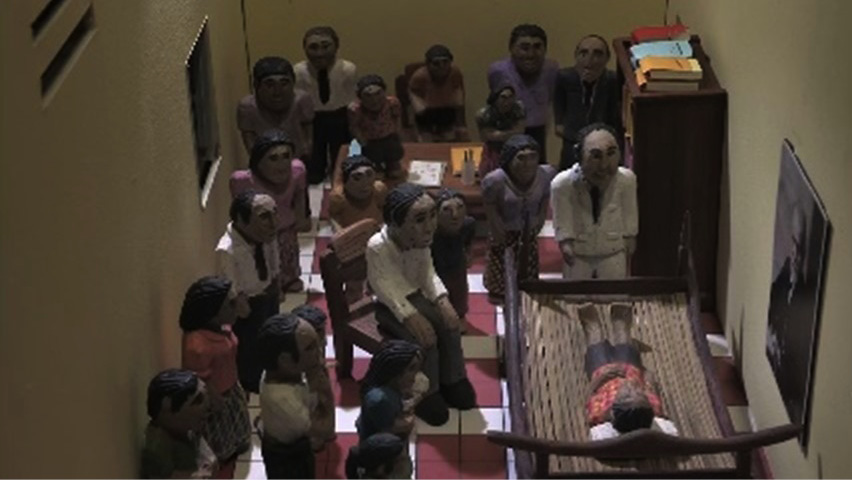
Metaphorically, the filmmaker states his work’s main foundation at its beginning, the need and the duty to bear witness. Thus, when he concludes his discourse at the end of the film, Panh repeats this cut of the sea waves. The need to bear witness returns, directly assimilated to trauma in a diorama that composes a psychiatrist’s couch and a painting by Freud, on a set that symbolically restores the family home (Besse, 2016: 30). A figurine of an adult Panh, who becomes the child he was through a chained fade-out, tells his story. Nowhere in the story is the filmmaker’s realisation of confronting his memories presented as explicitly as in these final moments on the psychiatrist’s couch (fig. 7). It is a synthesis of a personal and autobiographical approach that had not been developed in Panh’s previous films, which were more focused on others’ discourse.
Fig. 7. Panh remembers his family on the divan
Source: Still from The Missing Picture
Leaving aside somewhat the reconstruction of lost images, the narration in this last segment of the film takes on the tone of an essay on his own person. Different figures appear progressively in the small room, representing him, his mother, or his father, at different childhood moments. They all have expressions that denote the pre-Khmer Rouge period and are dressed in pre-Khmer Rouge attire as they observe him lying on the couch. The white-clad father is prominent among these figures, whose construction we see at the film’s beginning but was never placed on a diorama. The intimate discourse about the past and all its irreparable losses give way to the frustrated encounter with the child the filmmaker once was.
Now it is the child who is looking for me.
I see him.
He wants to talk to me.
But words are difficult (Panh, 2013b: 65).
From the psychiatrist’s divan, the propagandistic images of the revolutionary regime are projected directly onto the filmmaker’s head through an overlay. The film configures its traumatic content in these fragments, characterised by the “disruption and fragmentation of the narrative and stylistic regimes of the films” (Walker, 2005, 19). A sequence then opens, preceding one of the last reconstructions of the film. A small pit in the diorama with a figure inside representing a corpse is covered with shovelfuls of dirt. However, a quick chained fade brings the figure back to the surface to be covered again. This gesture is repeated in a seemingly endless loop to reflect the process of the young Panh’s work as an undertaker. An everyday life reduced to constant labour ends up homogenising all the victims into a single one, the anonymous figure buried repeatedly and who could well be the figure of the filmmaker, as Olivier Besse (2016: 33) indicates (fig. 8). “It is as if the burial operation had become cyclical, eternal, impossible to consummate, but also impossible to leave behind, giving rise, consequently, to an imprescriptible anguish” (Sánchez-Biosca, 2016: 68).
While these images are being shown, the narrated discourse tries to wield the foundations of the film one last time, the need to give truthful testimony of what has been experienced:
There are many things that man
must neither see nor know,
and if he did, it would be better for him to die.
to die.
But if any of us sees these things
or know them,
then he must live to tell the tale (Panh, 2013b: 68).
Fig. 8. The burial of the child

Source: Stills from The Missing Picture
The realisation that the narrator is still alive, despite the enormous traumatic burden he carries, “I am the one they are going to kill, or maybe they already have,” provokes the elaboration of the discourse of his memory. A dissertation aims to denounce the crimes committed and pay homage to the dead. At this point, the film is defined as eminently political, “a political film must discover what it has invented,” albeit frustrated. Panh himself confesses to having failed in his search for this absent image. This is how the creation of missing images arises from nothingness in an operation in which the filmmaker turns the film’s receivers into heirs in charge of transmitting the memory, that is to say, “The reader-spectator-receiver becomes the depositary of a transmission, of a knowledge that he absolutely must return, circulate in turn” (Lefeuvre-Déotte, 2016: 5). This is how this absent image is offered:
And this absent image,
I now offer it to you,
so that it will not cease
to seek us out (Panh, 2013b: 69).
These final verses postulate the need to fight against forgetting by replacing the black holes and false versions of history. “An image that emerges from darkness is an image that emerges from shadows or indistinction and comes to meet us” (Didi-Huberman, 2015: 21). But which image is Panh referring to? The last one in the film brings back the sequence of the sea waves hitting the camera. This time in black and white, the grey and greenish colours that the water acquires when the lens is completely submerged are thus suppressed. The act of bearing witness is proclaimed, searching for an absent image as a process, even if the result is unsatisfactory.
To establish this message, the director shows the construction of the present work, together with fragments from the filming of his previous works at the end of the film. While the credits scroll on the left side of the screen, some images show all the artifices behind the cinematographic apparatus on the right side of the screen. And what can be discovered, condensed into a few shots, is that there is no trick; instead, it has been created from a lengthy research process, set and costume construction, and the man... Panh himself, alone with his camera performing some of the cross-cuts and camera movements we have seen throughout the film. This preparation scene is shown before his own performance. The image expands and allows the viewer to see that the figures of Cambodians attending a music concert in the street are only part of a film, directed by other figures; the director, cameraman, and technicians, who are in charge of filming this mise-en-scène. Figures who reconstruct the lost images of pre-revolutionary Cambodia. Figures, they, too, join the cause of searching for the absent image.
5. Conclusions
The Missing Picture is based on the problem that there is hardly any graphic probing documentation despite the existence of millions of victims. In this sense, the film goes a step further in Panh’s enquiries into representation, replacing interviews and theatrical games with the filming of clay figures. The use of inanimate animation thus aims to freeze those absent moments fixed in the filmmaker’s memory. Thus, the work also represents a change in Panh’s position concerning the medium of film, abandoning the discourse of the others (victims and perpetrators), which was developed in his previous works to construct a narrative of his own.
Based on the act of witnessing from the first person, Panh composes a lyrical text that recovers all those lost images of the genocide for the camera. His personal perspective as a victim is thus opposed to the images of the perpetrators, which are contextualised as part of the barbarity. However, the structure of the work progresses from this search for general images of the genocide to the capturing of his own experiences. This is how the filmmaker ends up discovering himself confronted with the trauma of his past.
The iconography that sought to create a realistic representation of the past is used to fantasise about reconstructing the past; the director’s childhood is redefined from the present. Panh supplants the harshest and most violent images with fantastical constructions produced by a child’s mind. In this way, the present trauma of the horror of the past can be reconfigured positively –with a colourful shirt replacing the black uniform of the prisoners or with the act of flying as an escape– or negatively, with the burial of the inner child. This generates a new documentary approach, substituting veracity for poetic construction, which the filmmaker would later develop in Exile.
Admitting the impossibility of recovering all the absent images, the final plea of the voice-over reconfigures the concept of testimony as resistance. The spectator is thus called upon to configure new representations as memory holes. The process of image production replaces the promise of the absent image. In this sense, Panh’s inanimate animation functions as a bridge between Los rubios (2004) and Habeas Corpus (2015), also embodying the theoretical foundations on which to sustain ethics of representation of traumatic memories applied transnationally. In this way, a postulate of representation is consolidated that can be complemented with other strategies such as the animated documentary (Waltz with Bashir), poetic discourse (Nostalgia for the Light), or games of interpretation (The Act of Killing) to make up for the lack of traumatic archive images.
6. Acknowledgements
Article translated by Sophie Phillips.